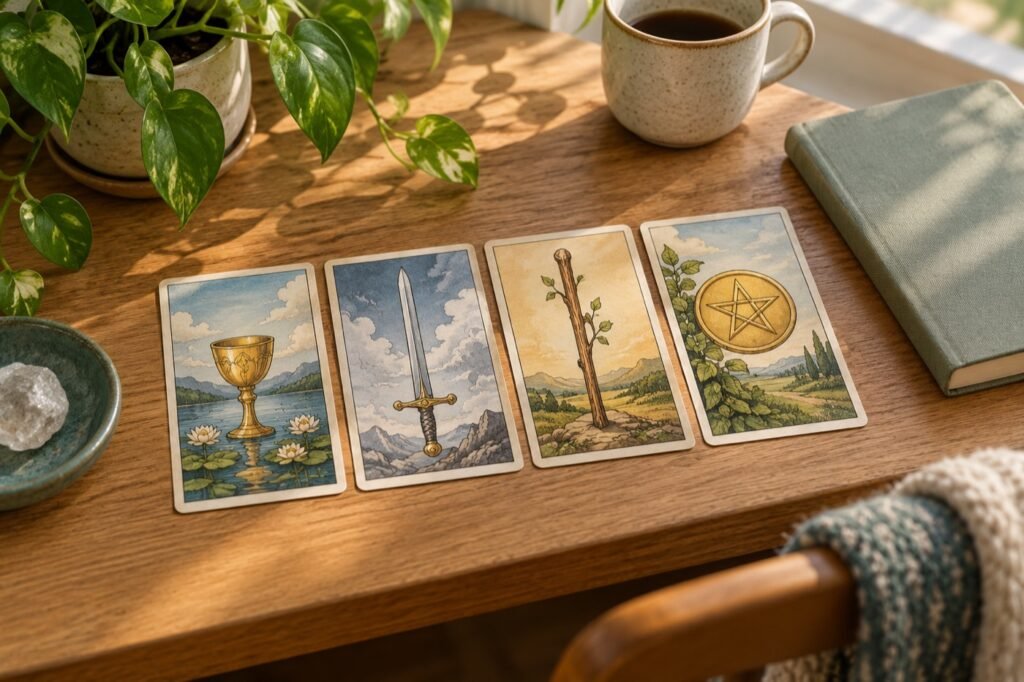
Choose an easy format
Your journal can be a notebook, a sheet of paper or a note on your phone. Use something you can already access comfortably. Decorative pages and scoring systems are unnecessary. A short entry in your own words is more useful for this exercise than copying a lengthy interpretation.
Keep the record private. On a shared device, avoid other people’s names and intimate details. The InfosPixel tool does not ask for your journal or store your question.
Try this five-line template
- Date: when you tried the exercise.
- Question: an open, concrete prompt.
- Card: the name that appeared.
- My reading: how the theme relates to an actual situation.
- Small step: a manageable action with a beginning and an end.
Write before looking up a longer explanation. This helps separate your observation from the text you read afterwards. You do not have to fill every line on busy days.
A complete example
Date: today. Question: “How could I make mornings less rushed?” Card: Temperance. My reading: “I am answering messages while trying to get everything ready”. Small step: “Put what I need by the door before checking messages”.
The person writing created this connection between the card and their routine. It is not evidence that the deck identified the cause of a problem. Another reader may choose a different association for the same card, which is consistent with symbolic reflection.
Review without finding signs everywhere
At the end of the day, add one sentence: “What happened when I tried my action?” Include what did not fit the interpretation. Recording only coincidences produces an incomplete picture. If nothing was useful, leave room for that conclusion too.
After a week, look at patterns in your choices. Were smaller actions easier to finish? Were the questions clear? Were you using a reading to postpone a conversation? The journal examines your practice rather than proving special powers.
Know when to put the cards away
If you repeatedly draw cards, feel distressed by their names or depend on readings for ordinary tasks, pause. Try a concrete activity, talk to someone you trust or seek appropriate support. You do not need to “correct” one card with another.
Use suitable information and professionals for medical, financial and safety decisions. Journaling is optional reflection and entertainment. An entry can simply end with “I prefer not to interpret today”.
An invitation for tomorrow
Choose a smaller question next time, such as “which task deserves ten minutes of attention?”. Return to the tool when you wish, without maintaining a daily streak. You can also keep the same record without cards: a question, an observation and a small step stand on their own.