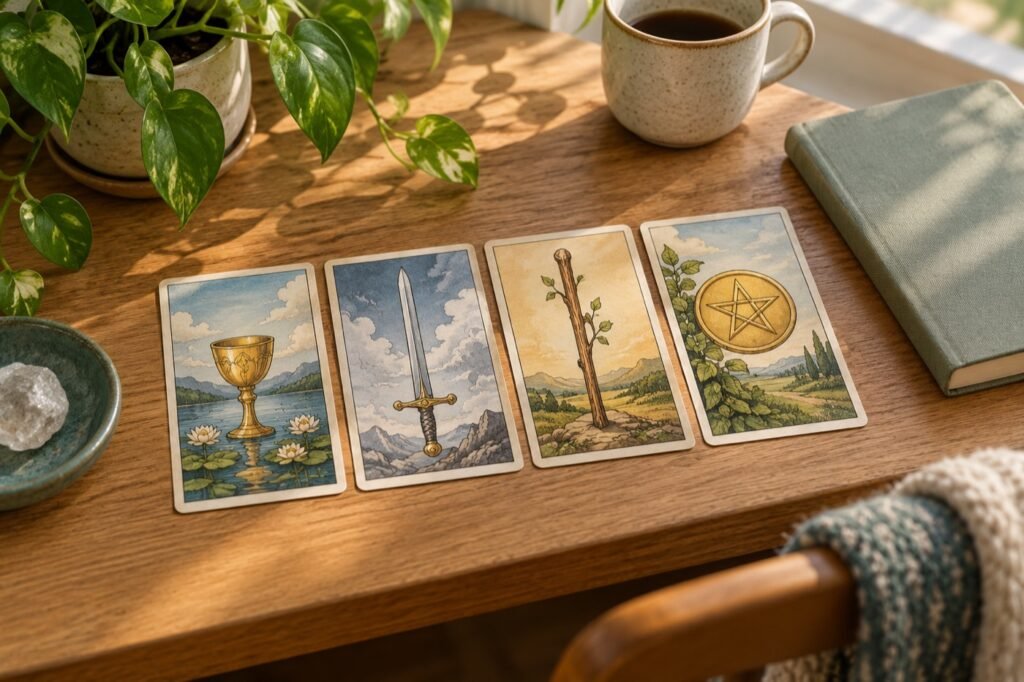
What the suits can help you notice
You do not need to memorize dozens of combinations to begin. In this exercise, the four suits act as reminders about relationships, choices, initiative and resources. These associations are our editorial reflection prompts, not universal rules or a way to uncover hidden facts.
The Metropolitan Museum of Art describes Cups, Swords, Batons and Coins among the symbols of fifteenth-century Italian cards. Names and designs vary between decks. That history does not validate the interpretations people use today.
Choose something small and familiar, such as arranging a visit or returning to a hobby. The aim is to widen your perspective while keeping responsibility for your decisions.
Cups: what happened in the conversation?
Use Cups to think about listening and relationships. Ask, “What did I actually hear, and what did I only assume?”. A short reply to a message could have several explanations. Record what was said and ask directly if clarification matters; a card cannot reveal another person's feelings.
One possible next step is drafting a clear sentence: “Could we agree on a better time?”. You do not need to send it immediately. First check that it expresses your needs without assigning motives to someone else.
Swords: which question needs clarity?
Here, Swords invites you to separate facts, assumptions and decisions. Suppose you keep postponing a cupboard tidy because you think it will take all day. The known fact may simply be that one shelf is full. How long it will take remains a guess.
Write a question you can investigate: “Could I sort the papers on one shelf in ten minutes?”. A specific question gives you a more useful next step than treating the suit as a warning of conflict.
Wands: what beginning fits today?
Use Wands as a reminder to start. Rather than promising to finish a project, choose a first observable action: open a notebook, select a photo or lay out a material. It should fit the time and energy you actually have.
If the plan feels too large, shrink the task. “Learn to use my phone” becomes “practice composing one message without sending it”. There is no requirement to be highly productive or continue when you need a rest.
Pentacles: what resources are available?
In this exercise, Pentacles draws attention to time, space and useful objects. Before buying anything for a new task, look at what you already have. A box, an envelope and an index sheet might be enough for a first organizing session.
Do not turn this suit into a promise of income. Ask, “What do I have, what is missing, and what could I simplify?”. For financial decisions, use reliable information and appropriate guidance rather than a reading.
A five-minute record
- Describe the situation in one sentence without asking for a prediction.
- Choose one of the four questions; drawing a card is optional.
- Write down one observed fact and one assumption to check.
- Choose a small action within your control.
- At the end of the day, note how your understanding changed.
For example: “Sunday visit. Cups: confirm the time with the person. Pentacles: count the chairs available. Next step: send a question about timing”. This organizes your attention; it does not guarantee how the visit will unfold.
Do I have to agree with the meaning?
No. If the association does not fit your experience, say so in your notes and stop. You can also use the four questions without a deck. In your journal, record what you noticed rather than tallying supposed predictions. Tarot here is symbolic reflection and entertainment, not a substitute for healthcare, financial information or professional support.