Choose a task you can finish
Clear a working surface and handle only the papers from one drawer or envelope. Leave the rest where they are. Mixing several locations at once makes it harder to remember where documents came from and finish your first session.
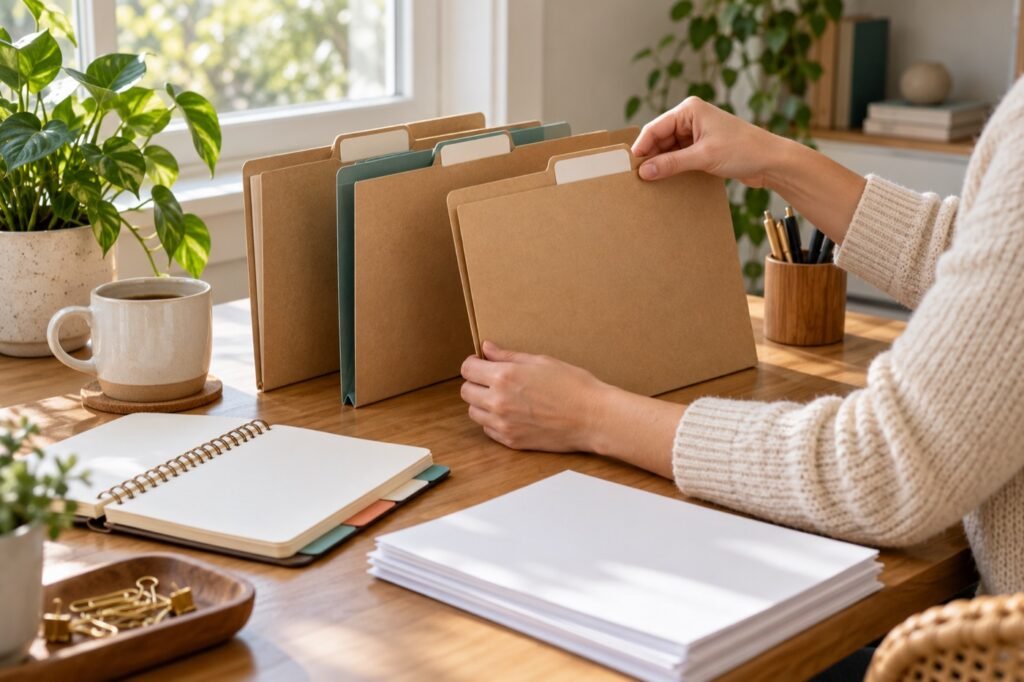
Prepare three areas before you begin: identify, file and act on. “Identify” holds papers you do not yet understand, “file” holds recognized documents, and “act on” holds items requiring a next step. Do not use this first sorting session to decide which originals to discard.
Create groups you will recognize
Choose names that would make sense if someone in your household needed to find something with your permission. You might begin with home, education, warranties and personal documents. These are organizing suggestions rather than mandatory categories.
If a folder becomes too full, split only that group. Education, for example, could have a divider for each person or course. Avoid creating many empty subcategories: a simple structure is easier to maintain when new papers arrive.
Use labels and a short index
A label should explain what a folder contains rather than simply say “important”. If you sort by date, state the order on its first sheet. You might place the most recent item at the front and use that rule consistently within the group.
The index is a location list, not a copy of your documents' contents. Write something like “washing machine warranty: Warranties folder, Kitchen divider”. There is no need to copy identification numbers or sensitive information onto a sheet that may be left in view.
A complete example
- Take the papers from just one drawer.
- Keep manuals and receipts relating to the same product together without sticking them to each other.
- Make a Warranties folder with a divider for each product if needed.
- Add each set's location to your index.
- Put unidentified papers in a temporary envelope and write down the next action.
Do not let that envelope become another unnamed drawer. During your next review, pick one item and find out what it relates to. If you cannot decide alone, ask the issuer or someone with relevant knowledge, without sending personal copies to strangers.
Consider the storage location
Belo Horizonte's public archive recommends keeping documents away from direct sunlight, heat, damp and leaks. It also advises keeping food and drinks away while handling papers and avoiding repairs with adhesive tape or school glue.
Choose somewhere accessible to you, protected and appropriate for the material. If you find a fragile or damaged document, avoid improvised restoration. Set it aside carefully and seek conservation guidance when necessary.
Organizing does not set retention periods
This guide does not provide a universal rule for throwing documents away. Retention depends on the document, its purpose and applicable requirements. Before destroying an original, check with the responsible institution or an appropriate professional.
A photograph or scan may help you consult a document, but this article does not claim that it replaces the original. If you make a digital copy, keep it in a protected location and use consistent filenames. Avoid posting photographs of documents or sharing them in group chats.
Keep reviews small
Choose a short review session that fits your routine. File new arrivals, deal with one pending item and check that the labels still make sense. If something takes too long to find, adjust that group's name or location.
A useful test is to find a familiar document using only the index. If you can locate it and return it to the same folder, the system is already doing its job. Improve the rest gradually without buying a complete set of storage products.